

Why Laurie Lawrence Changed His Approach to Teaching Babies to Blow Bubbles
The Laurie Lawrence philosophy on teaching babies to blow bubbles has changed since he first started teaching swimming in 1975.
In the early days, Laurie would introduce blowing bubbles quite early in the learn-to-swim process. This approach is documented in his book Sink or Swim.
Today, however, Laurie’s approach has shifted. His updated philosophy on teaching babies is reflected in his new online Baby Swimming Resource, which brings together his current knowledge, teaching methods and experience from more than 50 years of teaching babies to swim.
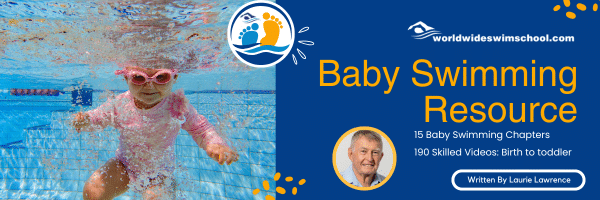
The interactive, video-based resource explores the swimming and developmental journey of babies and toddlers, combining written information with more than 150 videos. It provides practical guidance for parents, carers, swim teachers and educators, helping them better understand how babies develop skills and confidence in the aquatic environment.
Explore Laurie Lawrence’s Baby Swimming Resource
One of the key changes in Laurie’s approach is his focus on teaching babies under two to hold their breath while swimming short distances, rather than introducing bubble blowing early in the learn-to-swim process.
So, why has Laurie changed his approach?
Why Breath Holding Comes First for Babies
Over the years, Laurie noticed that when babies blow bubbles underwater, they must eventually take a breath in. If they are still underwater when they experience this natural urge to breathe, they may inhale or ingest water.
This can be upsetting and potentially dangerous for young babies, particularly because they do not yet understand what is happening.
Most children under two are not yet physically capable of independently lifting their head out of the water to take a breath. For this reason, the focus is on teaching babies to swim short distances while holding their breath, as well as developing a “turn and return” skill so they can return to a ledge or a place of safety.
This building-block approach allows babies to develop the physical skills they need before introducing more complex breathing patterns.
Learning to Breathe Independently
In the following video, you will notice that Harper, who is 2 years and 4 months old, is able to pop up and take a breath independently.
She is still quite vertical when she does this, but she is learning to move from a vertical to a horizontal position and will become more proficient with practice.
Strengthening kicking skills is very important at this stage because strong kicking helps the child move from a vertical to a horizontal position.
Now that Harper is physically capable of popping up for a breath, we can start to introduce the concept of blowing bubbles.
Teaching Babies to Blow Bubbles
Blowing bubbles becomes a fun game for Harper to play with her Poppa. This underwater activity is actually developing explosive breathing, but it is being introduced through play and exploration.
The bubble-blowing skill can also be extended and practised on a shallow-water ledge, where the child practises the crocodile position.
The crocodile, bubble and breathe activity is very effective because it helps ensure the child remains in a horizontal position while learning to breathe.
Communicating the Building-Block Approach to Parents
Communicating this building-block approach to parents is very important. Parents need to understand why each skill is being introduced and how it contributes to their child’s overall swimming development.
When you communicate your knowledge and explain the purpose behind the activities, parents are more likely to understand the learning process and remain engaged from week to week.
A skill such as blowing bubbles can easily be overlooked by a parent who does not understand its purpose. They may simply see it as play, without recognising the important learn-to-swim skills being developed.
As swim teachers, it is our job to help parents understand that play is an important part of learning to swim.
Learn More About Laurie Lawrence’s Baby Swimming Philosophy
Laurie’s approach to teaching babies has continued to evolve through decades of teaching, observation and experience.
His new Baby Swimming Resource brings together his current approach to infant and toddler swimming in an accessible online format. With more than 15 chapters, over 150 videos and more than six hours of video learning, it covers topics including breath control, submersion, propulsion, turning and movement, parental involvement and the developmental benefits of introducing babies to water.
The resource is designed for parents, carers, swim teachers, swim school operators, early childhood educators and other professionals who support young children around water.
View and purchase the Baby Swimming Resource
To find out more about World Wide Swim School and explore our catalogue of professional development resources for swim teachers, visit our Swim Library catalogue.